
Wednesday, February 16, 2022

Saturday, March 3, 2018
5G news
Deutsche Telekom, Intel and Huawei Achieve World's First 5G NR Interoperability in Operator Environment
[Bonn, Germany, February 23, 2018] Deutsche Telekom, Intel and Huawei prove the world's first 5G interoperability and development testing (IODT) based on the 3GPP R15 Standard with a commercial base station in an operator lab environment. This successful test in Bonn, Germany, is another important milestone after the three partners initially verified the first 5G NR interoperability in Huawei’s Shanghai labs.
The test is based on Huawei's 5G commercial base station and Intel's third generation 5G NR Mobile Trial Platform (MTP). It is a critical step towards the early development of full commercial 5G equipment in 2019, accelerating the 5G ecosystem.
Deutsche Telekom and Huawei began cooperation on 5G network research in 2015 and committed to accelerating the development of the ecosystem. With the benefit of Intel's 5G NR platforms, the group realized successful IODT tests taking crucial joint steps towards 5G industry maturity.
Using Huawei's commercial NR base station and the Intel 5G NR Mobile Trial Platform, the three parties have jointly validated the fundamentals of the 5G 3GPP NR standard completed on December 21, 2017, at the 3GPP TSG RAN meeting in Lisbon, Portugal. These included new synchronization, coding, frame structure, and numerology components underlying the interconnection of the NR-compliant terminal and network.
The test configuration used by Deutsche Telekom, Huawei and Intel is based on the largest C-band cell bandwidth defined by the 5G NR standard. It also incorporates the latest Massive MIMO multi-antenna and beamforming technology enabled by the standard framework.

World's first 5G NR Interoperability test based on 3GPP R15 commercial system
Arash Ashouriha, Senior Vice President Technology Innovation of Deutsche Telekom said: ”After delivering leading contributions to the 3GPP’s work on 5G standards, Deutsche Telekom, Huawei and Intel moved swiftly to jointly achieve implementation progress through standards-based interoperability testing. The successful testing in our 5G:haus operator environment is another significant step on the path to 5G ecosystem maturity and early 5G commercialization.”
Yang Chaobin, President of Huawei’s 5G product line, said: "The success of this testing in Bonn shows that Deutsche Telekom, Intel and Huawei continue to work closely to drive the commercial readiness of 5G NR. As the standard continues to be updated, Huawei will continue to work with all parties to step up additional interoperability tests and promote the 5G industry maturity process, and to welcome the arrival of the entire industry digitization.”
Asha Keddy, Vice President Client, and General Manager Next Generation Standards, Intel Corporation, said: "Intel has been actively working with leading 5G companies to take advantage of Intel's unique end-to-end 5G NR technology and to accelerate 5G testing and commercialization based on the latest 5G NR technology. The Intel®XMM™8000 modem family maturity and time to launch will significantly benefit from this early multi-vendor interoperability progress and the realization of a global 5G NR industry ecosystem, with initial launches in mid-2019 and large-scale scaling in 2020.”
The maturity of the 5G industry is the foundation of 5G NR commercialization. Deutsche Telekom, Intel and Huawei will continue to deepen their cooperation and develop standardized products for the upcoming 5G era.
Monday, February 15, 2016
Tuesday, February 2, 2016


NEXT GEN CASING FOR GAMING PC
mini-ITX chassis
NZXT has launched the "breakthrough" Manta mini-ITX chassis. In typical bombastic fashion the firm claims that it has taken "ITX to a whole new level with a revolutionary design and uncompromising quality". The quality claim will be held up by the reputation of NZXT but of course its revolutionary style and beauty is in the eye of the beholder. But if you do like it, you might find that the beauty if more than skin deep - NZXT says that the curvature of this chassis provides excellent cable management routing options.

Johnny Hou, NZXT founder and CEO, told HEXUS in an email "NZXT strives to deliver meaningful innovation across every product we are designing. Manta, our first ITX case, provides an innovative and efficient answer to the ITX equation for PC users who are looking for effortless and superior build".

A new manufacturing process is said to be used to make the curved steel panels (new to NZXT maybe), and it proudly compares the curves and lines of the Manta mini-ITX chassis to a sport car. The look and appeal is enhanced by a curved glass side window. This large glass side panel is optional - as some prefer 'stealth'. The NZXT Manta also includes rear I/O lighting which can be turned off via the I/O panel.

I think that's enough talk about the look/quality of this chassis and it's time to consider the specs:

As you can see from the above specs, the Manta, despite being a mini-ITX chassis, isn't very small, or light. However it might appeal on the design front and still satisfy the requirements of many an enthusiast looking to build a new PC. In 'power user' feature terms it offers dual 280mm liquid cooling support (Kraken X61 ready), a purported double the cable management space to aid airflow, and integrated PSU shroud, a fully filtered system, and generous capacity for large graphics cards. There's an integrated PWM fan hub, SSD display and satisfactory easy access I/O panel
The NZXT Manta mini-ITX chassis is available for pre-order now in Matte White/Black, Matte Black/Red, and Matte Black with or without a windowed side panel. Price is £99.99 +VAT / €139.99 +VAT, with shipping/availability in February.

NEXT GENERATION GAMING PC
NEXT GENERATION GAMING PC
System integrators are always on the lookout for new ways of standing out from the crowd, and what better way to differentiate than with an eye-catching chassis? Deepcool's awesome-looking Tristellar certainly fits the bill, and Cyberpower is one of the first to adopt the unique enclosure as part of its Trinity range of gaming base units.
available in a choice of Intel or AMD configurations, the Trinity systems offer many of the usual hardware options but do so in a form factor that's a) different to the norm and b) guaranteed to turn heads.

It looks fantastic, wouldn't you agree? There's definitely a sci-fi feel about the chassis - it would look right at home in an episode of Battlestar Galactica - and we suspect Cyberpower will sell plenty of units based on looks alone. Yet while Deepcool's Tristellar is up there with In Win's transforming H-Tower as one of the most intriguing enclosures we've seen in recent years, you might be wondering what's it actually like to live with.
Attempting to be functional as well as enticing, Tristellar is split into three 'cabins,' one for a graphics card measuring up to 320mm in length, another for a mini-ITX motherboard, and the third for power supply and storage. Connecting the three cabins together is a hollow, hexagonal aluminium spine that neatly allows cables to pass from one section to the next while also doubling as a backlit power button at the front end.
The arrangement works surprisingly well, and in separating the hot-running components, the theory is that the system should run suitably cool at all times. Indeed, the chassis itself is equipped with only a single fan - a 92mm intake attached to the front of the graphics-card cabin - while a pair of unfiltered vents on the chassis' base enable airflow to the CPU and PSU sections.

But of course, a case as quirky as this is going to come with restrictions, and these are evident in every cabin. The graphics card section is hooked-up via a short PCIe extension cable, however there's only a single PCIe interface so you'll never be privy to SLI or CrossFire expansion, and water-cooled cards such as Fury X are out of the question. The motherboard cabin is restricted to mini-ITX, and for your CPU you'll either need a low-profile air cooler or a 120mm radiator. And finally, the third cabin has a maximum PSU length of 160mm, ruling out some of today's high-end units.
Careful component selection is key, and Cyberpower has done a good job of installing some seriously powerful hardware into our Trinity 300 review sample. This is the second-best offering in the Trinity range and fetches a jaw-dropping £1,999.
For two grand, Cyberpower equips the system with an ASRock X99E-ITX/ac motherboard, a hexa-core Core i7-5820K processor overclocked to 4GHz, a Cooler Master Seidon 120 liquid cooler and a reference-cooled, mildly overclocked MSI GeForce GTX 980 graphics card (model 4GD5 OCV1). Filling in the gaps, DDR4 memory is provided by 16GB (2x8GB) of Kingston HyperX Fury, power is provided by a 600W Cooler Master supply and storage is taken care of by a 250GB Samsung 850 Evo SSD as well as a 2TB Seagate hard disk.
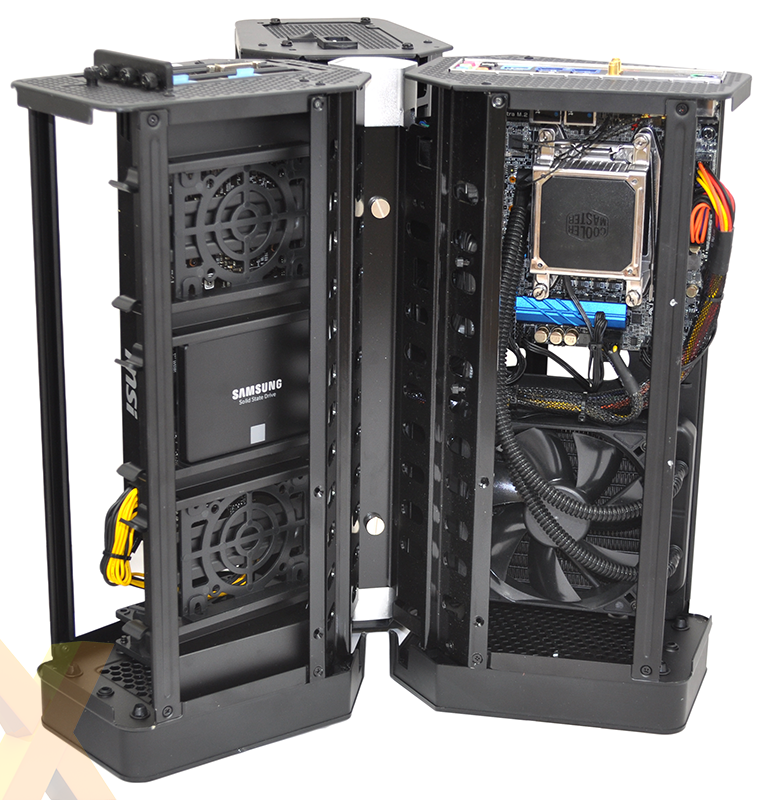 | 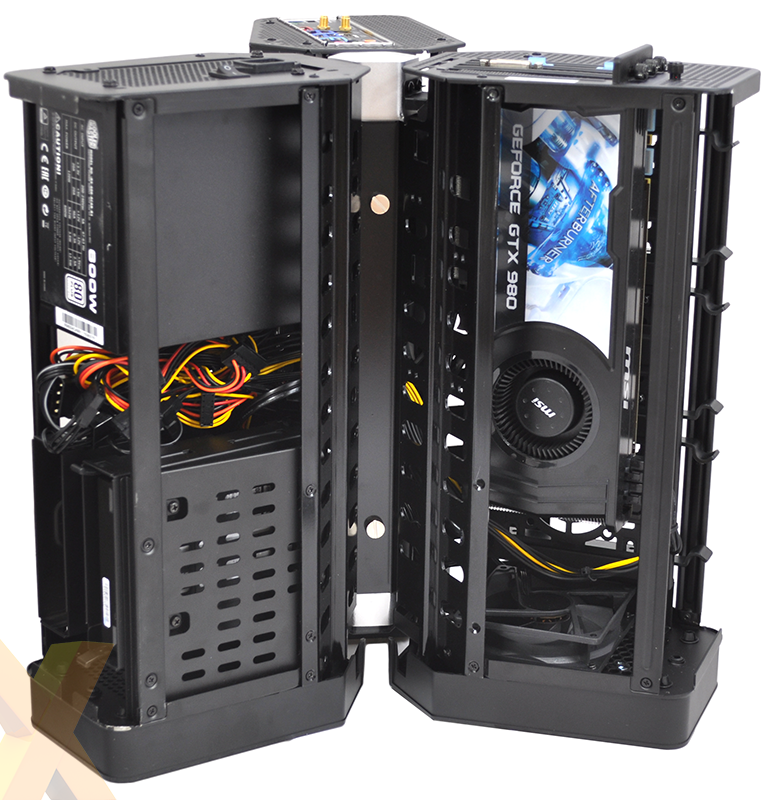 |
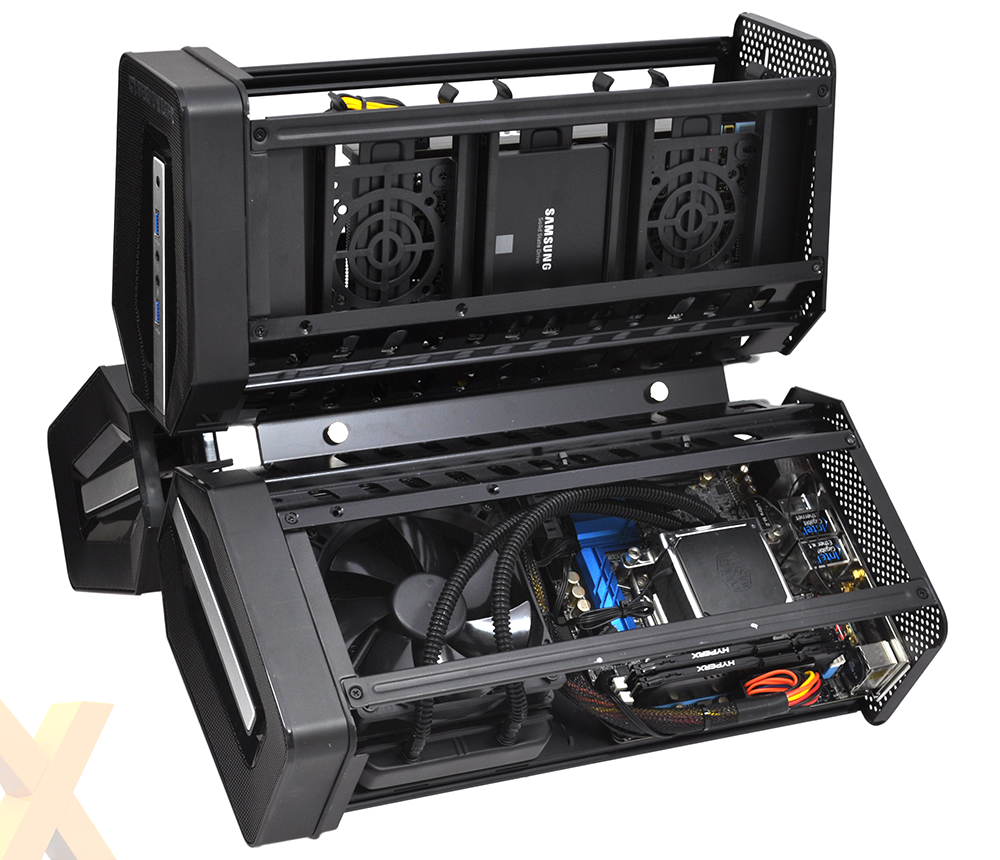
Undoing half-a-dozen thumb screws and removing the full-metal casings provides a better look at the internal layout. We can see a trio of 2.5in SSD bays housed alongside the graphics card, while the PSU bay has dual 3.5in hard disk trays sandwiching a slot for an optional slimline optical drive. Choosing to install the latter would neatly replace one of the silver strips on the chassis' front face, though you'd ideally want a silver drive to maintain the overall aesthetic.
Cyberpower's implementation is neat and tidy throughout, however the system's unusual chassis does raise a couple other question marks. Firstly, each cabin's metal shroud weighs over 3kg, and they combine to make the system inordinately heavy. Secondly, for what's essentially a mini-ITX PC, the Trinity 300 is by no means small. In fact, it measures 395mm (L) x 435mm (W) x 388mm (H) in size, making it one of the largest PCs to ever hold a mini-ITX motherboard.
And then there's the most obvious hurdle: the £1,999 price tag. For that amount of money, you really do expect GTX 980 Ti graphics at the very least, and if you prioritise performance, you'll know that a more traditional build would offer more bang for your buck. With Trinity 300, you pay a premium for the unique enclosure. Want to try saving a few bob by building a similar machine of your own? Deepcool's chassis alone will set you back a cool £500.
The good news for gamers who aren't enamoured with Intel's X99 platform is that Cyberpower does have a slightly cheaper Z97 variant. The Trinity 200 makes use of a Gigabyte Z97 motherboard and when equipped with, say, a Core i5-4690K processor and GeForce GTX 980 Ti graphics, would shave a couple of hundred pounds off the asking price of the X99-based Trinity 300.
There were always going to be trade-offs with a system as unorthodox as this, but none thus far can be considered deal breakers. Let's now see if performance and cooling are up to scratch.
Friday, December 18, 2015
Waterproof Sport Camera
Waterproof Sport Camera


Specifications
| Item no.: DVR001-WIFI | |||
|---|---|---|---|
| Solution | SUNPLUS 6330 | ||
| Waterproof Depth | 30M | ||
| Color | Black, White, Silver, Yellow, Blue, Pink, Gold | ||
| Image Resolution | 12M/8M/5M/3M/2M/VGA/1.3M | s | |
| Video Compression Format | H.264 | Default Resolution | Video:1080P, Picture: 4032*3024 |
| Video Format | MOV | ||
| Zoom | x4 digital zoom | Lens | 140° HD wide-angle fish-eye lens, nondeformable |
| Memory | Slot for Micro SD card up to 32 GB | ||
| Connections | USB 2.0 | HDMI | 70mins(1080P) |
| Battery | Detachable 900mAh | Dimensions | 29.8*59.2*41mm |
| Applications | Extreme sports, outdoor sports activities, bicycle, car DVR, diving, home security, etc. | ||
| OSD language | English/French/German/Spanish/Italian/Portuguese/Simplied Chinese/Japanese/Traditional Chinese/ Russian |
|---|
| WIFI Distance | 15M |
|---|
| Image Format | JPEG |
|---|
| Video Resolution | 1920*1080 30fps/1280*720 60fps/848*480 60fps/640*480 60fp |
|---|
Saturday, February 14, 2015
The next generation of TV----- Ultra HD and glasses-free 3D
The next generation of TV++++ Ultra HD and glasses-free 3D
Well here's something you don't see every day. A TV that not only enables you to watch 3D without any glasses on, but also sports a native Quad HD or Ultra HDresolution.
In fact, no television before the Toshiba 55ZL2 has been able to offer either of these hugely significant features. So it's fair to say the TV will rightly be looked back on in the years to come as the start of what is looking likely to be a new era in television technology.
It's a pity, then, that the 55-inch Toshiba 55ZL2 arrives with a couple of clouds hanging over it. First there's the fact that when we've seen its glasses-free 3Dsystem in action at numerous technology shows over the past 18 months, it's left us feeling distinctly unimpressed.
Second, it's always seemed - until very recently, at any rate - as if Toshiba's only interest in using a 4K screen was as a means of producing a convincing glasses-free 3D image. So it remains to be seen if the Toshiba 55ZL2 really gets the most out of its 4K talents.

Admittedly 4K is a tricky proposition right now on account of the lack of any 4K source or connection standards. But Sony has managed to get 4K working via a high-powered PC and a normal HDMI port and cabling on its VW1000ES 4K projector, so let's pray Toshiba has done the same with the 55ZL2.
The Edge LED Toshiba 55ZL2 also has Toshiba's Places online system, and its pictures are driven, reassuringly, by Toshiba's ultra-powerful Cevo Engine processing system - a system that worked wonders with the recent Toshiba YL863 and Toshiba WL863 series.
The Toshiba 55ZL2 is the only 4K, glasses-free 3D TV in Toshiba's range right now, and sits miles above (in terms of price as well as spec) the next model down - the aforementioned WL863 and YL863 models.
Although we've tried to come up with a couple of alternative TVs from other brands in the 'Also consider' section at the end of this review, the bottom line is that the Toshiba 55ZL2 is, for now at least, so groundbreaking that it's genuinely unique. But is its uniqueness enough to justify you spending £6,999 (about $11,215) to secure one?
Features
There are four fundamental things you need to know about the Toshiba 55ZL2 right off the bat. First, it's a 55-inch TV. Second, it's the first commercially released TV in the UK to support glasses-free 3D playback. Third, it's the first commercially released TV in the UK with a native 4K resolution of 3840 x 2160 pixels. And fourth, the price of all this startling innovation is a cool seven grand (or about $11,215).
This latter fact will likely make the Toshiba 55ZL2 nothing more than a pipe dream for most people. But its glasses-free 3D and 4K features naturally make it a TV of huge importance and interest from a technical point of view.

The 55-inch screen for Toshiba's futuristic TV is very pleasantly dressed, thanks to its extremely slender black and silver bezel, plus its unusual but appealing rectangular desktop stand. It sticks out further round the back than most of today's Edge LED TVs, but this seems a minor aesthetic price to pay for the heavy-duty tech tucked inside.
Connections are interesting. Among the standard stuff we'd expect of any self-respecting high-end TV these days are two USBs capable of multimedia playback of film, photo and music files, and a LAN port for either networking your computers to the TV or taking the TV online with Toshiba's Places platform.
There are four HDMIs, too, again as you would expect, as well as a little slot for attaching a D-Sub PC feed via a provided adaptor. What certainly isn't normal, though, is the unique digital serial port input facing straight out of the Toshiba 55ZL2's top rear corner.
4K Quad HD
This digital serial port is there because at the time of writing it's the only way to get native 4K source images into the Toshiba 55ZL2. Unlike the Sony VW1000ES 4K projector, the Toshiba 55ZL2 does not appear to have any support via its HDMI ports for getting 4K in that way.
This is significant, because it means that really there's no way of getting 4K video into the screen at all, unless you use the special Toshiba HDD server supplied exclusively to high-end retailers. The only 4K images a normal person will be able to experience on the TV will be from digital still photographs supplied to the TV via the USB ports.
This is a huge disappointment of course, and may well make you wonder why the heck the screen uses a 4K resolution at all if you can't actually use it properly. But the answer to this lies in the Toshiba 55ZL2's glasses-free 3D capabilities.

The way the TV uses an array of lenticular lenses to direct different images to your left and right eyes to create a 3D effect means that only a 4K panel has sufficient resolution to deliver glasses-free 3D images that still look anything like HD in resolution.
Given how interest in 3D appears to be waning while interest in 4K is growing fast, Toshiba's decision to apparently focus on 4K resolution as a means to a 3D end rather than as a key feature in itself might seem rather bizarre. However, let's not forget that work started in earnest on the Toshiba 55ZL2 a good 18 months ago, when the short-lived period of 3D fever was at its height and consumers were forever saying they'd only get into 3D properly if they didn't have to wear 3D glasses.
Also, of course, there's the sad but unavoidable fact that 4K sources are about as common as pasta trees. A state of affairs that doesn't look set to change any time soon.
Still, Sony has managed to at least make its VW1000ES projector able to take 4K sources from a massively high-spec PC via HDMI, so it's an almighty shame that Toshiba doesn't seem able to do the same. At least that would have given us leave to talk about the potential for future 4K video content delivery to the Toshiba 55ZL2.
Glasses-free 3D
The glasses-free 3D feature on the Toshiba 55ZL2 needs more explanation. It's already been noted that it uses a lenticular lens system on the TV's screen to deliver the necessary offset images to each eye.
But it should be added that the Toshiba 55ZL2 is able to deliver these offset images not to just one 'sweet spot' but to as many as nine. This is a potentially critical improvement over early glasses-free 3D televisions we've seen, which have only delivered a credible effect from one or maybe two precise viewing points.
Toshiba even has a tracking system in the Toshiba 55ZL2 whereby a camera built into the TV scans the room for faces and adjusts its viewing sweetspots accordingly. Very clever - and something that's only possible because the 55ZL2 employs Toshiba's powerful Cevo Engine processing.
Image processing
The presence of this processing unsurprisingly filters into numerous other areas of the Toshiba 55ZL2 too. For starters, as with the Toshiba 46YL863, which also uses Cevo Engine processing, you can get your TV to auto-calibrate itself with the help of the TPA-1 colour meter. This plugs into one of the TV's USB ports, so that it can use the measurements it takes from a built-in set of test signals to adjust various aspects of the TV's settings.
There are a couple of problems with the TPA-1, though. First and foremost, it's not included for free with the Toshiba 55ZL2, despite the TV's massive asking price. Instead it costs £200-£250 (around $315-$400) extra. Also, we've found the calibrated pictures the TPA-1 produces to be a little imperfect, leaving reddish tones looking slightly muted and out of balance.
The Cevo Engine system is at play in the Toshiba 55ZL2's general picture processing too, since it powers an 800Hz effect achieved through a combination of a 200Hz native panel, a scanning backlight and frame interpolation.
Perhaps the area where the Cevo Engine will most earn its corn, though, is in its upscaling of normal Full HD and even standard definition sources to the screen's native 4K resolution. This potential for making Blu-rays look even sharper and more detailed than they do on a good Full HD TV is arguably the set's main attraction - unless you're a 3D obsessive - given the set's apparent inability to play native 4K video through any practical channels.
Delivering this upscaling is a turbocharged version of Toshiba's previously acclaimed Resolution+ system, complete with different levels of processing power when it comes to adding sharpness to the image.
The Toshiba 55ZL2's on-screen menus reveal control, too, over the potency of the TV's motion compensation systems; MPEG and standard noise reduction systems; a genre-based set of picture presets including three 'Hollywood' modes; colour and gamma management systems; and something called a Slant Line remover, which proves very good at removing the jaggedness that can appear around upscaled curved edges.
Online content
Wrapping up the Toshiba 55ZL2's potent feature mix is its Toshiba Places smart TV service. This is unfortunately probably the set's most underwhelming attraction, at least when considered against the online services available from other big brands these days.
The problem is that it just doesn't have enough content. Video services aren't too bad, including as they do the BBC iPlayer, YouTube, Acetrax, Viewster, Daily Motion, Box Office 365, Woomi, Cartoon Network and HiT Entertainment - though there's no Netflix or LoveFilm support.
However, while there are a few minor other bits and bobs scattered around the Places services, including Twitter and Facebook support, overall there's just no escaping that you can get way more video, gaming, information and social networking apps from the latest TVs from Sony, Samsung, LG and Panasonic.
Saturday, December 20, 2014
WHAT IS Li-Fi
Li-Fi TECHNOLOGY FOR NEXT GENARATION
Li-Fi is a new paradigm for optical wireless technology to provide unprecedented connectivity within a localized data-centric environment. The increasing demand for higher bandwidths, faster and more secure data transmission as well as environmental and undoubtedly human friendly technology heralds the start of a major shift in wireless technology, a shift from RF to optical technologies.

The Li-Fi Consortium has several purposes:
- Promote optical wireless communications up to the multi-gigabit range in all their implementations;
- Inform potential implementers and investors of the companies and resources available to help them achieve their product or investment goals;
- Create whole solutions in anticipation of customer needs, and
- Coordinate with standardization groups and other industry organizations to provide OEM customers with a complete ensemble of technical and marketing support.

Li-Fi TECHNOLOGY
As a general rule, all technology shown on this website is developed by one of our members and is open for licensing. We also are able to tailor the Li-Fi technology shown to your specific solution or application. If you are interested, please make contact through our contact page and we can explore possibllities.
During the last few years, we mainly have focused on technology development with respect to data transmission speed. This was done in relation to different user scenarios. We developed new docking technology as well as wireless high speed data transfer for beaming and providing users with wireless data broadcasting and a wireless data hotspot based on high speed Li-Fi technology. For more information about the different technological approaches, please, use the technology links in the sidebar menu on the right.

The table above shows the general landscape of wireless RF (radio frequency) communication technology compared with IR (infra red) communication technology, related to transmission speed and range (distance). The green area indicates the technological abilities of our currently available developments.

This table shows the different data rates of the technological solutions we offer. The related interface and wireless range (distance) provides an insight into the technological abilities of our developed products.

A wireless local area network based on Li-Fi technology needs some additional features to provide the same qualities as an RF-based wireless network, without losing the main advantages Li-Fi technology is able to provide. Here are the missing links for a fully developed Li-Fi WLAN.
The Li-Fi room connector

Optical signals are not able to penetrate walls. This is an advantage in relation to security issues. However, in order to provide an optical wireless local area network, rooms need to be connected with each other. This is achieved via the Li-Fi room connector. The Li-Fi room connector is a replicator which sends the data stream from one side of the wall to the other via an optical fiber cable, which connects the two room connectors on each side of the wall. With smaller rooms, the Li-Fi room connector might be sufficient as the only Li-Fi hotspot in the room.
The Li-Fi router

The Li-Fi router is the networks connection to the external link (fiberoptic cable, DSL, GigE, etc.). The application is mainly useful for small office or home use with cloud & server functions. It connects office and/or entertainment equipment and covers a radius of 20 meters with a 100 Mbps transmission speed. The product is developed to a proof-of-concept stage.
The full features Li-Fi cloud

The Li-Fi cloud is a software solution enabling the user to control all the features within a datacentric Li--Fi environment. Part of this software has been developed already in connection with the developments of the Li-Fi applications we offer today.
OPTICAL MOBILITY TECHNOLOGY

The extended mobility concept of the Li-Fi Consortium is based on state of the art optical receiver chip technology. The architecture of the optical receiver chip is based on a biological design: The eye of a fruit fly. The fly eye design has a revolutionary architecture and impressive capabilities. It uses an optical sensor array, which is faceted like a fly’s eye. It has a wide field of view, implemented with multiple narrow fields of view elements. It is able to read reflections of light and overcomes with that the limitations of the typical optical Line-of-Site connectivity. The chip is able to identify the signal (+ transmitter) position in both angle and range.
With this development, mobile devices do not depend on a line of sight connection between sender and receiver. Fly eye receiver chips will be able to read reflections, also of very weak signals. Its large dynamic range is the basis of our mobility technology. The chip supports multi-channel high-speed communication while also tracking the transmission source electronically, with no moving parts. This enables “communication on the move”: That is a moving transmitter communicating with a fixed or even moving receiver.
This technology has been developed to concept stage and needs investment in chip development.
Subscribe to:
Posts (Atom)